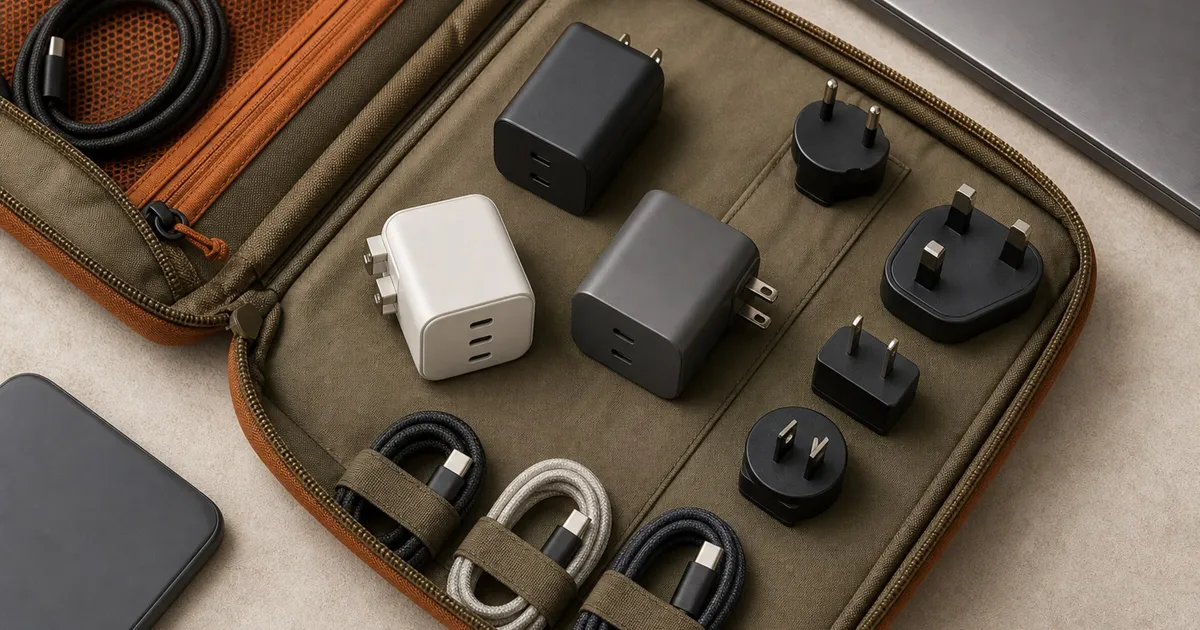
For laptop-and-phone travel, the documented adapter kit and four-port allocations make Satechi 145W our international-travel pick, while Anker A2688 is the compact domestic option. Belkin WCH014 publishes a detailed high-power port table, and UGREEN 15202 is a three-port alternative. Total wattage is not enough: the deciding number is the allocation with every device connected.
Quick picks
- Satechi ST-W145GTM: the travel-specific four-USB-C option when interchangeable outlet adapters and a documented four-device split matter.
- Anker Prime A2688: the smaller US-wall option when a 65W laptop path plus 35W second USB-C path is enough.
- Belkin WCH014: the four-port choice with the clearest published all-port and PPS tables, but without a universal plug kit in the US box.
- UGREEN Nexode Pro 15202: the three-port alternative when the listed device combination fits and you are willing to verify the missing allocation details.
Start with the devices, not the wattage headline
List the exact laptop, phone, tablet, watch charger, and USB-A accessory you intend to connect. For the laptop, note the power adapter rating and whether the USB-C input uses 20V or 28V USB Power Delivery. For the phone, identify whether its fastest wired mode depends on PPS. This turns a vague search for “more watts” into a port-by-port requirement.
A 140W total does not mean every USB-C port can supply 140W, and it does not mean the first port keeps that output when the others are occupied. Satechi and Belkin publish unusually useful multi-port allocation tables. Anker publishes the key A2688 combinations, including the 89W three-port total. UGREEN’s available official page is less complete, so a buyer who needs an exact three-device split should treat that missing matrix as unresolved rather than filling it in from a similar model.
Leave margin for the laptop to remain usable while charging. A laptop that ships with a 100W adapter may run on a 65W share during light work but charge slowly or lose battery under a heavy CPU and GPU load. That behavior depends on the computer, not merely the charger. If a work trip includes sustained rendering or gaming, preserve the higher-power port for the laptop and move smaller devices to a second charger if necessary.
Our international-travel pick: Satechi ST-W145GTM
Satechi’s exact manual names ST-W145GTM and includes US, EU, UK, and AU outlet adapters. All four outputs are USB-C. C1 and C2 can each reach 140W alone; C3 and C4 can each reach 45W alone. With all ports occupied, the documented splits are 65/30/25/20W or 30/65/25/20W.
That makes it the most travel-specific design here, but cables are separate. Use 5A e-marked USB-C cables for high-power laptop paths and verify that the laptop accepts the listed USB PD voltage. A retail listing may use a store SKU that differs from the model number in the support documents, so confirm ST-W145GTM on the packaging before relying on these specifications.
Check Satechi 145w USB C GaN Travel Charger on Amazon.
A compact US wall charger: Anker A2688
Anker’s A2688 has two USB-C ports and one USB-A port. Either USB-C port can deliver 100W alone under the documented profile. With both USB-C ports active, output becomes 65W + 35W; all three ports total 89W. A cable is not included, and Anker specifies a 5A e-marked cable for 100W operation.
That is a good fit for a 60W-class laptop plus phone, but less suitable when the laptop needs close to 100W while a second device is connected. Anker publishes a 24-month US Prime-charger warranty. Anker’s published A2688 documents do not specify the exact PPS APDO range, so check phone fast-charging compatibility by protocol rather than assuming it from PowerIQ branding.
Check Anker Prime A2688 100w Charger on Amazon.
A detailed four-port split: Belkin WCH014
Belkin’s WCH014 provides three USB-C PD ports and one 12W USB-A port. C1 can deliver 140W alone. With all ports active, Belkin documents up to 65W + 45W + 20W + 12W, bounded by 140W total. The published table also includes PPS ranges for all three USB-C ports.
The US version uses a built-in foldable two-prong plug. International versions use detachable travel plugs, so do not assume a US box contains adapters. Belkin states a two-year warranty and explicitly says the charger is not a surge protector and is not USB-IF certified.
Check Belkin WCH014 140w GaN Charger on Amazon.
UGREEN 15202: verify the exact phone and allocation
UGREEN’s US page identifies SKU 15202, two USB-C ports, one USB-A port, and 100W total output. It lists PD and PPS support on the USB-C ports, but the available official documentation does not provide every PDO, APDO, or multi-port allocation. Macworld reports 65W + 30W for C1 + C2 and 65W + 22.5W for C1 + USB-A, but those are review observations rather than a complete official matrix.
Check Ugreen Nexode Pro 100w 15202 on Amazon.
Cable capability is part of the power path
The charger, cable, and device negotiate together. A high-power USB-C port cannot deliver its rated maximum through every cable. For 100W operation, use a 5A e-marked cable rated for that power. USB PD 3.1 paths above 100W require an Extended Power Range cable and a compatible source and device. A cable bundled with a phone may be intended for lower power even when its connectors look identical.
Cable length and data speed are separate decisions. A short charge-only cable can be appropriate for a travel charger even if it is not a fast data cable. Conversely, an expensive high-speed Thunderbolt cable does not guarantee that a particular device accepts the charger’s highest profile. Label the cables that have known ratings instead of relying on color or thickness.
Count cables in both price and luggage space. Satechi and Anker do not include the high-power cables needed for their headline laptop paths. Belkin package contents vary by region and listing. Confirm the exact box rather than assuming a photographed cable is included. Carrying one verified spare can be more useful than buying a fifth charger port.
PPS and proprietary phone charging
USB Power Delivery is broad, but phone fast-charging modes are not all interchangeable. PPS lets a compatible phone request changing voltage and current within an advertised range. Belkin publishes PPS ranges for its USB-C ports. Satechi’s manual provides detailed PD allocation data. Anker does not publish the exact A2688 PPS APDO table in the documents reviewed here, and UGREEN’s complete APDO detail was not available from the cited US material.
Check the phone manufacturer’s charger requirements and compare them with the exact port, not merely the charger’s brand-level protocol list. Some phones may fall back to ordinary USB PD and charge correctly but below their advertised maximum. That is a compatibility outcome, not proof that the charger is defective. If the fastest phone mode is essential, prioritize a published matching profile over another unused port.
USB-A is mainly a compatibility convenience in this group. It can keep an older watch puck, camera cable, or accessory useful, but occupying it may change the USB-C allocation. Read the all-port row that matches the real travel kit.
Outlet format, input voltage, and mechanical fit
Satechi is the only option here built around a documented set of US, EU, UK, and AU outlet adapters. That reduces the need for a separate shape adapter in those regions, but it does not replace checking the charger’s input-voltage label or local outlet rules. A plug adapter changes physical fit; it does not convert voltage for equipment that lacks universal input.
Anker, Belkin US, and UGREEN US use foldable North American blades. They may be compact at home but still need a quality destination adapter abroad. A heavy charger can sag from a loose wall outlet, especially when several cables pull sideways. In that situation, a short rated extension lead that complies with local rules may provide a more stable arrangement than stacking adapters, but hotel and country restrictions vary.
Also inspect clearance. Wide bodies can block an adjacent outlet, and an outlet behind furniture may not leave room for a charger plus four cable bends. The best travel layout may be a slightly larger charger that sits securely rather than the smallest body in a marketing photo.
Warranty and long-term fit
Anker publishes a 24-month US warranty for the cited Prime charger, and Belkin states two years for WCH014. For Satechi and UGREEN, read the terms tied to the seller and region you will use. Warranty duration does not prove electrical reliability, but a clear claim path, model number, and purchase record reduce ownership friction if a port stops working.
Keep the exact model and regional suffix in your records. Similar charger names can cover different plugs, allocations, or generations. Recheck the manual after a replacement because an outwardly similar unit may use another SKU. Stop using any charger or cable that develops a loose connector, damaged insulation, unusual odor, visible deformation, or unstable output, and follow the manufacturer’s support process rather than attempting a repair.
Build the power budget
- Find the laptop’s normal USB-C input requirement and whether it needs 20V or 28V USB PD.
- Write the exact port combination you will use, then read that allocation row.
- Check PPS support for phones that rely on it for their fastest USB-C charging mode.
- Add suitable cables; a 100W or 140W port cannot deliver that power through every cable.
- Distinguish a US foldable plug from a true travel-adapter kit.
- Do not treat GaN, total wattage, or a flammability-material statement as proof of complete-product safety certification.
Evidence boundary
No independent lab set covers all four exact US models under one sustained-output, efficiency, temperature, reconnect, and plug-durability protocol. Individual reviews and teardowns use different methods. This article therefore compares official port tables, package contents, regional plug design, and warranty. It does not rank thermals, efficiency, electrical safety, or long-term reliability.
Sources
For a compact hub or dock decision centered on a handheld rather than a laptop, see our USB-C hubs for Steam Deck guide.
- Anker A2688 product and manual and warranty: https://www.anker.com/products/a2688-anker-prime-charger-100w-3-ports-gan and https://service.anker.com/product-description/a08J1000000XmldIAC
- UGREEN 15202 product page and Macworld allocation review: https://us.ugreen.com/products/ugreen-nexode-pro-100w-gan-fast-charger and https://www.macworld.com/article/2434362/ugreen-nexode-pro-100w-3port-gan-fast-charger-review.html
- Belkin WCH014 FAQ and allocation table: https://www.belkin.com/support-article/?articleNum=335765 and https://www.belkin.com/au/support-article/?articleNum=335917
- Satechi ST-W145GTM manual and power distribution: https://support.satechi.com/hc/en-us/articles/48830432488859-User-Manual-145W-USB-C-4-Port-GaN-Travel-Charger-ST-W145GTM and https://support.satechi.com/hc/en-us/articles/50976115396635-Power-Distribution-145W-USB-C-4-Port-GaN-Travel-Charger-ST-W145GTM