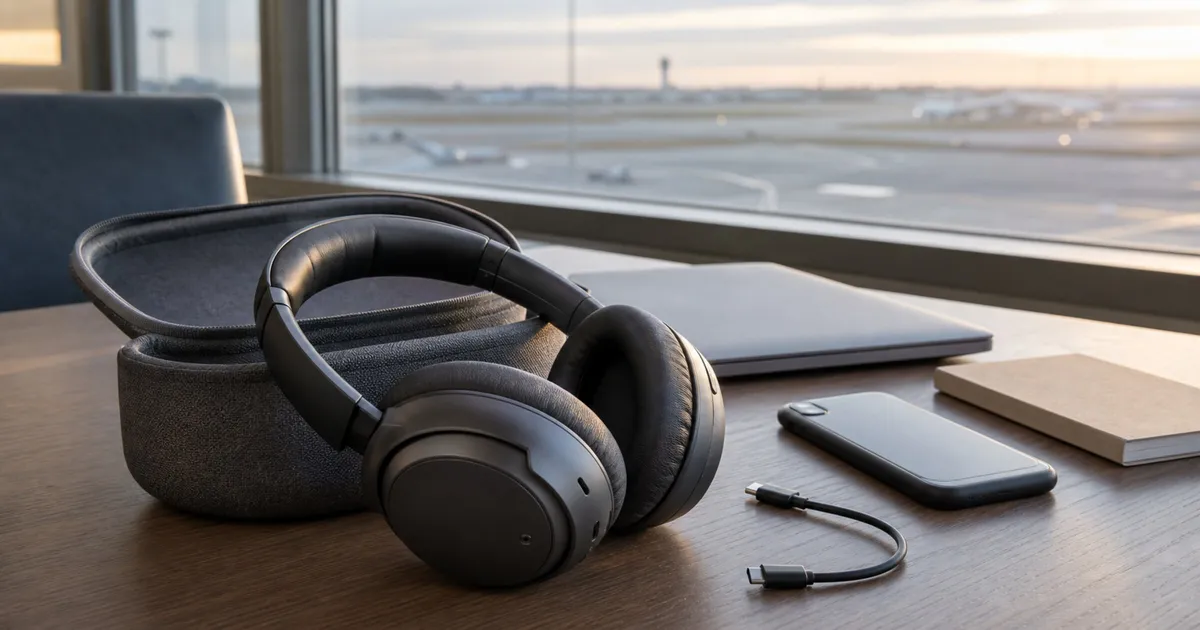
Based on exact-model RTINGS v2.3 results and the manufacturer compatibility records reviewed here, Sony WH-1000XM6 is our balanced travel-and-call pick. Bose QuietComfort Ultra 2nd Gen is a comfort-led alternative, Sennheiser Momentum 4 is the battery specialist, and AirPods Max 2 A3454 makes the most sense inside an Apple setup.
How the four options differ
The product comparison uses the shared RTINGS v2.3 measurements only where they support a narrow comparison, then adds manufacturer-documented connection and service limits. Sony is the balanced cross-platform choice, Bose is the comfort-led alternative, Sennheiser is the battery specialist, and AirPods Max 2 is the ecosystem-specific choice. A single “best ANC headphone” label would hide too many differences in call path, host, fit, and repairability.
Separate noise cancellation from call performance
Active noise cancellation and microphone noise handling solve different problems. ANC tries to reduce what the wearer hears. The call microphone system tries to preserve the wearer’s voice while limiting what the far end hears from the surroundings. A headphone can isolate cabin rumble well and still transmit distracting café noise on a call. It can also sound clear to the wearer while the conferencing app selects a different microphone than expected.
That distinction changes how to read a lab result. The cited exact-model isolation measurements are useful because the four models share a method version. The microphone observations are also useful, but they do not guarantee the same result in Teams, Zoom, FaceTime, a mobile carrier call, or a laptop with aggressive processing. Bluetooth profile, host operating system, application settings, and the room all take part.
For a fixed desk, a separate microphone can make the capture path easier to control than a travel headset. Our Shure MV7+ versus Elgato Wave:3 MK.2 comparison separates close-spoken call setup from one-computer streaming mixes.
Fit is a third variable. A break in the ear-cup seal can reduce low-frequency isolation, and glasses, hair, jaw shape, and head size can create that break differently for each person. Comfort judgments are similarly personal. Manufacturer weight and one lab’s fit notes narrow the shortlist; they cannot tell you whether the headband creates a pressure point after your own two-hour flight.
This is why a travel-and-call recommendation should be a compatibility decision. Identify the devices, the noisy places, the expected call duration, and whether you need the microphone while wired. Then use a return period to evaluate those exact conditions rather than treating a composite score as universal.
Our balanced pick: Sony WH-1000XM6
Sony gives the XM6 a useful travel mix: two-device multipoint, SBC, AAC, LDAC, and LC3 codec support, powered or unpowered 3.5mm listening, and a relatively light 254g manufacturer weight. RTINGS’ exact-model v2.3 record measured 31.75 hours of continuous battery and found strong overall isolation. Its microphone assessment describes generally intelligible, full voice reproduction that degrades in harsher noise.
That does not make it the right headset for every conference room or head shape. Calls use the phone microphone when the analog cable is connected, and seal can change with glasses, hair, and anatomy. Sony Sound Connect handles settings and firmware; the available sources do not provide a complete product-specific data-retention matrix.
Sony is the easiest default here when a traveler regularly moves between two ordinary Bluetooth devices and still wants an analog fallback. The codec list should not drive the choice by itself: the source device must support the desired codec, and call mode may use a different Bluetooth path than music listening. Multipoint is more concrete for a laptop-and-phone workflow because both devices can remain paired, though transitions should still be tested with the applications you use.
The unpowered 3.5mm path is useful when a battery is depleted or an in-flight system supplies only analog audio. It does not preserve the headphone microphone for a wired phone call. Pack the correct cable and decide whether “wired backup” means listening only or a full headset requirement.
Check Sony Wh 1000xm6 on Amazon.
A comfort-led alternative: Bose QuietComfort Ultra 2nd Gen
Bose documents two-device multipoint, USB-C digital audio, analog listening, and aptX Adaptive on compatible Snapdragon Sound devices. RTINGS measured 37 hours of continuous battery and reported very strong isolation with a light, comfortable fit for its tester.
Calls remain configuration-dependent. RTINGS found a natural voice with satisfactory but incomplete noise rejection, and it reports that the microphone is disabled on wired paths. The Bose app is not required for base listening, but settings and updates use it, and some app functions can require an account.
Bose makes sense when the lighter fit observed in the cited review matters more than having a wired microphone. USB-C digital and analog listening broaden the playback options, but neither should be assumed to provide a headset mic on an arbitrary host. If your work policy requires a wired microphone, verify another headset rather than hoping a firmware or app setting changes the documented path.
Support for aptX Adaptive is also conditional. Both the headphone and the transmitting device need compatible support. A laptop that only exposes standard codecs does not gain the feature from the headphone alone. Treat it as a host-specific bonus, not the foundation of the purchase.
Check Bose Qc Ultra Headphones 2nd Gen on Amazon.
The battery specialist: Sennheiser Momentum 4 Wireless
The Momentum 4’s 62-hour RTINGS result is the longest common-method result in this exact comparison. It supports two-device multipoint, SBC, AAC, aptX, aptX Adaptive, USB digital audio, and analog playback. Ear pads are replaceable, while the integrated battery is routed through service.
The tradeoff is calls in noise. RTINGS describes the microphone as passable but weak at preserving the speaker’s voice against background sound. It also found strong isolation overall but weaker attenuation of very-low-frequency rumble than the leading options. Sennheiser’s current US service catalog says non-warranty internal service for this exact model is unavailable because repair is uneconomical, while pads and cables remain replaceable.
The measured battery result can reduce charging anxiety on a long itinerary, but it should not erase the call and lifecycle tradeoffs. A traveler who works from a loud terminal may care more about microphone voice preservation than another thirty hours between charges. Someone who mainly listens and takes calls from hotel rooms may reasonably reverse that priority.
Replaceable wear parts are valuable because pads affect comfort and seal, yet they do not make the integrated battery field-replaceable. Include the service position in total ownership cost. The longest battery result at purchase does not guarantee the longest usable life over several years.
Check Sennheiser Momentum 4 Wireless on Amazon.
For Apple integration: AirPods Max 2 A3454
This row is strictly the 2026 AirPods Max 2 model A3454, not 2024 USB-C model A3184. Apple documents USB-C lossless and low-latency audio and automatic switching among supported Apple devices on the same Apple Account. That switching is not ordinary simultaneous multipoint across arbitrary phones and laptops.
RTINGS measured 22 hours of continuous battery and found exceptional isolation. It also found that microphone performance varies with the connected device and described a heavier, higher-clamp fit that can fatigue some users. USB-C audio does not guarantee the microphone works on every laptop path.
The model identifier is critical because “AirPods Max USB-C” can also describe the earlier A3184 revision. This recommendation and cited measurement refer to A3454. Verify the exact model rather than assuming a color or connector establishes it.
Apple’s automatic switching is useful when the devices share the supported Apple Account setup. It is not evidence of simultaneous, vendor-neutral multipoint between arbitrary work and personal devices. A Windows laptop plus an Android phone is therefore a different buying problem from a Mac plus an iPhone. The 22-hour common-method result may be sufficient for many trips, but it is materially below the other three results and deserves a deliberate charging plan.
Check Apple Airpods Max USB C on Amazon.
Choose by the trip you actually take
- For frequent device switching across brands, prefer documented ordinary multipoint: Sony, Bose, or Sennheiser.
- For long-haul battery, Sennheiser has the longest common-method result here.
- For USB-C digital listening, Bose, Sennheiser, and AirPods Max 2 have documented paths; host microphone support still differs.
- For calls, consider the noise around you and the conferencing host, not just a generic microphone label.
- Buy from a seller with a workable return policy because comfort, clamp, seal, and glasses interaction cannot be universalized.
- Do not treat ANC headphones as hearing protection or tinnitus treatment.
For flights and trains
Prioritize seal, physical comfort, and the listening fallback your route demands. An aircraft entertainment system may require analog audio, while a phone or tablet may use Bluetooth or USB-C. Sony and Sennheiser document analog playback; Bose documents analog plus USB-C digital audio; AirPods Max 2 emphasizes USB-C audio. Pack the required cable or adapter and test it before leaving, because connector shape alone does not confirm host support.
Battery numbers here are controlled exact-model measurements, not a guarantee for every volume, codec, call mix, or feature setting. Use them to compare under the cited common method. For planning, leave margin rather than treating the final measured hour as available. A short top-up before a connection is simpler than discovering that a listening-only cable cannot handle the call you planned to take.
For calls in shared spaces
Choose the microphone path first. If the call must happen over Bluetooth, test the headset in the actual conferencing application and confirm its input and output selections. Record a local sample in quiet and with representative background noise, then listen for intelligibility rather than studio quality. This is a personal compatibility check, not a substitute for the cited standardized review.
If the call must be wired, none of the playback labels should be accepted as proof of microphone support. Sony’s analog path uses the phone microphone, and the cited Bose tests disable the headphone mic on wired paths. USB audio behavior can differ by host. A dedicated wired USB headset may be the more reliable work tool even if separate ANC headphones handle travel listening.
For multi-device work
Sony, Bose, and Sennheiser document ordinary two-device multipoint. That is the relevant feature when a work computer and personal phone need to remain available across brands. Still test what happens when audio starts on one device while the other receives a call. Automatic switching within Apple’s supported account ecosystem solves a different problem and should not be described as cross-platform multipoint.
Codec support belongs after that workflow decision. A high-quality codec can matter for listening, but both endpoints must offer it, and it may not govern call audio. Buying a headphone for a codec that your laptop does not transmit adds no practical value.
App, privacy, and support considerations
Each platform uses software for some combination of configuration and firmware. Before granting broad permissions, review which functions need an account, whether the app is required after setup, and what happens if you decline optional analytics or cloud features. The available Sony material does not supply a complete product-specific retention matrix, and the Bose account requirement varies by app function. Do not fill those gaps with an assumption of either total privacy or automatic data collection.
Firmware support matters because Bluetooth compatibility and device behavior can change over the life of a headphone. Replacement pads and cables can extend useful service when the underlying electronics and battery remain healthy. Sennheiser’s current exact-model service listing is unusually clear about unavailable internal non-warranty repair; use that evidence in a lifespan comparison rather than equating replaceable pads with a fully repairable product.
Clean pads according to manufacturer guidance, store the headphone without crushing the cups, and avoid leaving a lithium-battery device in extreme heat. Those basic habits do not establish a lifespan, but they avoid predictable wear. If the headset is essential for work, keep a simple backup rather than expecting one wireless product to cover every failure mode.
Who should buy which pair
Choose the Sony WH-1000XM6 for a balanced mix of cross-platform multipoint, isolation, battery, and analog listening, provided Bluetooth calls are the main call path. Choose the Bose QuietComfort Ultra 2nd Gen when its lighter comfort profile and isolation outweigh the lack of a microphone on the documented wired paths. Choose the Sennheiser Momentum 4 Wireless when long measured battery life is the priority and most calls happen away from heavy background noise. Choose AirPods Max 2 A3454 when supported Apple-device switching and USB-C audio are worth the shorter measured battery and heavier fit.
Skip all four if a dependable wired microphone is the non-negotiable requirement. A purpose-built work headset plus separate travel headphones may be less elegant, but it creates a clearer, testable call path.
Method and evidence boundary
All four exact models appear under RTINGS Headphones Methodology v2.3 and shared a June 23, 2026 bench update. That supports narrow comparisons of the lab’s public battery, isolation, microphone, and comfort findings. It does not prove long-term reliability, hearing benefit, every-head comfort, or performance in every call app. Manufacturer battery maxima are not substituted for RTINGS’ measured continuous-playback figures.
Sources
- Sony WH-1000XM6 guide and RTINGS review: https://helpguide.sony.net/mdr/2984/v1/en/contents/TP1001863304.html and https://www.rtings.com/headphones/reviews/sony/wh-1000xm6
- Bose QCUH2 product and guide and RTINGS review: https://www.bose.com/p/headphones/bose-quietcomfort-ultra-headphones-2nd-gen/QCUH2-HEADPHONEARN.html and https://www.rtings.com/headphones/reviews/bose/quietcomfort-ultra-headphones-2nd-gen
- Apple A3454 identification and RTINGS review: https://support.apple.com/en-us/109525 and https://www.rtings.com/headphones/reviews/apple/airpods-max-2
- Sennheiser Momentum 4 product, US service catalog, and RTINGS review: https://us.sennheiser-hearing.com/products/momentum-4-wireless , https://spares.sennheiser-hearing.com/catalog/product/509266-m4aebt-black , and https://www.rtings.com/headphones/reviews/sennheiser/momentum-4-wireless